What guests coming from afar really expect
Those who choose Como for an event seek credible Italian cuisine and service capable of reading different needs. Translating a menu is not enough: you need to build an understandable, curated, and coherent experience, where ingredients and preparations are enhanced also in the way they are described and served.
The most frequent requests fall into three areas:
- Understanding and trust: knowing what you’re eating and drinking, with simple and precise explanations (ingredients, style, allergens).
- Well-managed dietary needs: vegetarian/vegan, halal requests, gluten-free or other restrictions integrated into the project, not added at the last minute.
- Fluid communication in English: from the first call to on-site direction, because organizing from a distance requires clarity and speed in decisions.
Menu: italian authenticity made “accessible”
Building a menu for international guests requires cultural sensitivity and gastronomic competence. The most common mistake is to polarize: either staying on proposals that are too “niche,” or slipping toward generic cuisine that loses identity. The best way is to select Italian preparations that speak to different palates, keeping technique and raw materials at the center, with presentation that helps understand them.
In practice, menus built on clear pillars with seasonal variants work well:
- Fresh pasta (tagliatelle, ravioli, gnocchi) with appealing and well-executed sauces, from classic to more delicate versions.
- Risottos (saffron, porcini, seasonal vegetables): “iconic” dishes when the technique is explained and the consistency is perfect.
- Recognizable and well-calibrated main courses: meats and fish treated with precision, with seasonal sides that lighten and give rhythm.
- Italian appetizers: selection of cured meats and cheeses with bread, honeys and preserves, presented with order and care.
Inclusivity is designed from the start. Vegetarian and vegan options must be conceived with the same dignity as the others: deconstructed eggplant parmigiana, beet tartare with sour cream and sprouts, and basil risotto with tomato air can be main courses, not alternatives. For more specific needs (halal, kosher, severe celiac disease), the difference is made by method: suitable ingredients, separate processes, and careful contamination management.
Mixology: the cocktail as cultural bridge
For high-level events, mixology is not an extra: it’s often the first contact with the experience and the most immediate way to give “tone” to the welcome. A well-crafted cocktail communicates quality in a universal language, and allows you to tell the story of the territory without making it distant.
Personalized signature cocktails are often the most distinctive option: creations that integrate ingredients and aromatic profiles consistent with season and location (citrus, herbs, Italian spirits), with curated presentation and punctual service.
Alongside this, Italian classics like Spritz, Negroni, Bellini work very well when executed with superior ingredients and calibrated proportions: familiar, but clearly “high-level.”
And today a structured non-alcoholic offering is essential: mocktails built with botanicals, infusions, kombucha or shrub allow you to offer complexity and depth without alcohol, maintaining the social ritual of the toast.
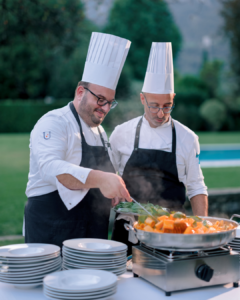
The value increases when the bar is not just service but a living point of the event: on-the-spot preparation, discreet interaction, continuous rhythm without lines or gaps.
Service and logistics in villa: what must not be seen but must work
Impeccable catering is also measured by what remains invisible: timing, discretion, and ability to manage unexpected situations without guests perceiving friction.
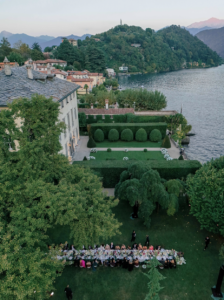
In contexts like historic villas or lakeside locations, the complexity is real: kitchens not always sized for events, architectural constraints, particular access points, magnificent outdoor spaces but variable weather. An experienced team works with clear procedures: site visit, technical areas layout, service flows, plan B defined beforehand (not improvised). When operational supports are needed, they’re managed in a sober and integrated way, so the location’s aesthetics remain the protagonist.
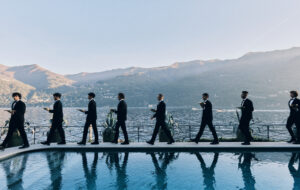
The direction of timing is equally decisive, especially if the day includes multiple moments (welcome, aperitif, dinner, after party). Each transition must be natural: setup and breakdown “behind the scenes,” staff present but never intrusive, flexibility on rhythm when last-minute variations emerge.
Budget and Transparency: building trust from a distance
When organization happens remotely, trust is born from readable estimates and unambiguous communication. Proposals that immediately clarify work better:
- cost per person and what’s included,
- any extras (bar, additional staff, equipment, mise en place),
- payment methods and modification/cancellation conditions.
Quality doesn’t depend only on the ingredient range, but on the solidity of service. Even at different budgets, what should remain constant is professionalism: method, timing, care, and ability to manage complexity.
In short, a catering and mixology service on Lake Como designed for international guests works when it combines authentic Italian cuisine, rigorous management of dietary needs, high-level mixology, and impeccable logistics direction in complex locations. It’s this balance between excellence and accessibility, between aesthetics and method that transforms a beautiful context into a truly memorable event.